Portfolio Introduction
This semester, Public Affairs Reporting has been an in-service in journalism. The opportunity to experience all facets of journalism while also learning about reporting on the District was engaging and informative. For me, the class revolved around the creation of journalism content, including interviewing, editing and creating multimedia tie-ins.
Writing news aligns with the phrase “practice makes perfect.” The time to revise my work at the end of the semester was eye-opening. The revisions allowed me the space to visualize how I have grown this semester. It is clear I have improved my writing most around using AP style and inputting attribution. I also appreciated our brief, but informative audio unit. Reading a children’s book aloud to practice tone, cadence, and pitch was fun. It also gave me a necessary perspective on how radio and podcasts, an essential part of the modern journalism landscape, are produced.
I experienced substantial growth this semester and it is evident in my work. For the business story, I worked on a story about the Anacostia Arts Center and the changes it is undergoing. One thing I struggled with in that story was attribution. In my final draft I said, “Randolph said she believes that an investment from Washington Area Community Investment Fund will help continue the cycle of nurturing creatives and their businesses before sending them into Southeast or other parts of DC.” Before editing, I described what the Arts Center wanted to do for the community without attribution. It made my article sound biased by assuming the center wanted the best for the community. Attribution provides an explanation and context from a reliable source.
Another time when attribution was necessary was in the neighborhood story. I wrote about the D.C. Attorney General’s lawsuit against Pepco: “In a statement on Twitter Schwalb said, ‘Pepco routinely discharged hazardous chemicals into the environment, contaminating the Anacostia River and threatening the surrounding communities’ health and safety.’” Similarly to the business story, I described the situation, but did not specify where I found the information. In this quote, the 5 W’s (who, what, when, where, how) are clear.
In the event story, I wrote about the Smithsonian Anacostia Community Museum’s farmer’s market. On the morning I visited, the air was cold and in my writing I described it as crisp. One of my classmates pointed out to me that “crisp” is my opinion; someone who is not from California might think the weather was balmy. To fix it I looked up the weather on the day I visited. I said, “On a 60 degree October morning, the Fresh Farm produce table drew patrons of the vegetable stand and museum-bound passersby who stopped to shop for produce.” I used facts instead of opinion.
I expanded my knowledge and skills in Public Affairs Reporting, but I can still improve. One section that needs work are the multimedia aspects. In the Pepco story’s video, I edited together video clips of my interviews with my own voice-over narration in between. I know now that the interviewees should create a narrative that viewers follow, no voice-over needed.
A DC Farmer’s Market Works to Combat Food Insecurity
Event Story
By Kayla Smernoff
Oct. 31, 2023
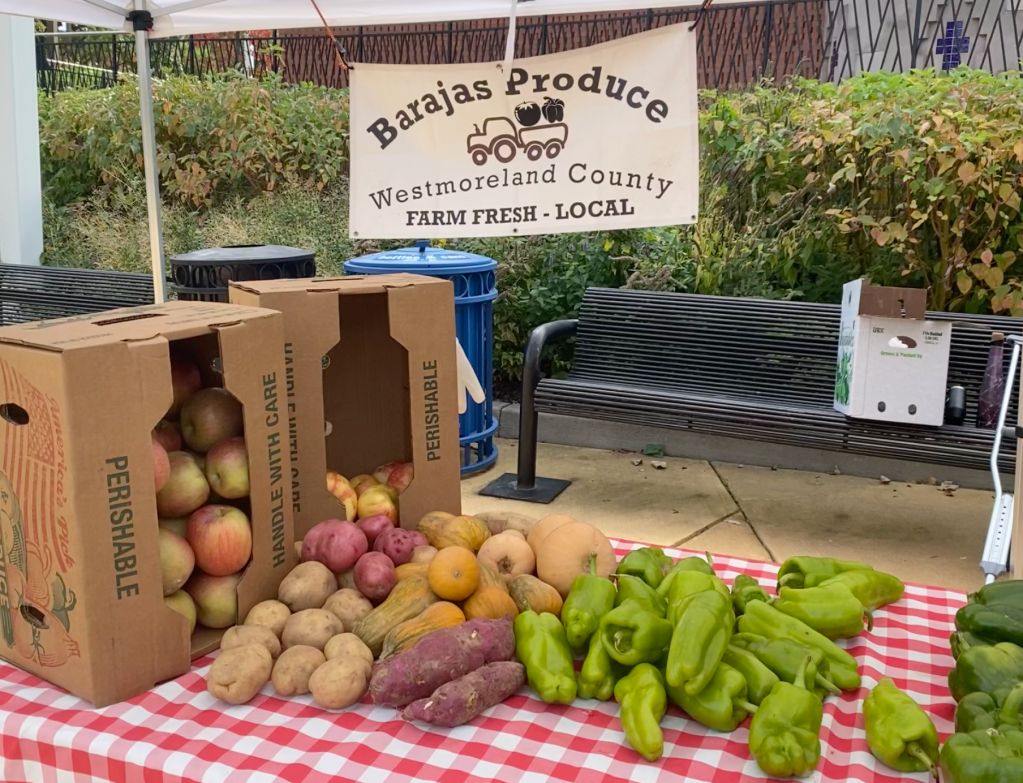
On a 60 degree October morning, the Fresh Farm produce table drew patrons of the vegetable stand and museum-bound passersby who stopped to shop for produce.
Customers shifted through the bright array of seasonal vegetables laid out on a red gingham tablecloth, asking questions and making small talk with the produce managers behind the table. The food displayed in front of the Smithsonian Anacostia Community Museum is in stark contrast with the lack of access to food, especially produce, in Ward 8.
Christopher Bradshaw’s Dreaming Out Loud administrators and educators at Ward 7’s Kelly Miller community farm said the lack of fresh, affordable food in Ward 8 is a “food apartheid” that is both “systematic and intentional.”
Fresh Farm’s Smithsonian Anacostia Community Museum offers a solution with their produce stand which raises and addresses concerns about food insecurity. 2023 is the first year having a farm stand at the museum, and October marks the last of the sessions of the stand for the year.
The Smithsonian Anacostia Community Museum website advertises the Fresh Farm stand as the company that “creates food access, economic development, and thriving communities” and as an adopter of Produce Plus, D.C.’s benefits program that gives produce to D.C. residents with little or no access to fresh and healthy food.
The Fresh Farm produce stand is full of locally grown, in-season fruits and vegetables. Sounds from the museum float around the farm stand creating an atmosphere and other options for shoppers who might not be incentivized to stop and shop by only the Fresh Farm produce.
Fresh Farm is a for-profit organization, but Price Holman, a farm stand manager at the produce stand, said the value of having fresh, local, organic, and seasonal produce evens out monetary comparisons with grocery stores.
“I like that you know where you are getting your food from and where it grew from,” said Aamiyah Stewart, a Maryland native and security guard at the Smithsonian Anacostia Community Museum.
The countryside ambiance of the museum and farmer’s market creates a communal space for patrons of both spaces.
“I think it’s really great to connect with your community, friends and neighbors. I learn about healthy alternatives and recipes from friends and the vendors,” said Chloe Mason, a Howard student and frequent attendee of the Columbia Heights Fresh Farm Saturday market.
The stand is Fresh Farm’s “only federal partnership,” said Holman. The Anacostia Smithsonian is pioneering a new way to reach food insecure audiences. Each fruit and vegetable is from a farm within 200 miles of Washington D.C. Many of the employees are local as well.
In Ward 8, the D.C. ward that houses Anacostia, Bellevue, Navy Yard, Woodland and eleven other neighborhoods, there is one grocery store: the Giant Food on Alabama Avenue.
Recently the representative for Ward 8, Trayon White, spoke about the shoplifting in the Giant Food. “We cannot afford to hurt ourselves by constantly taking from the store, because that means everybody is going to be without a place to eat, and enough is enough,” said White.
According to Trayon White, people in Ward 8 do not have access to healthy produce and Giant Food is reaping the costs in the form of shoplifting.
The cycle of food insecurity is consistent when, as Trayon White said, residents take from grocery stores and then the stores shut down. White did not respond to one of his resident’s concerns that gentrification brings grocery stores, instead of community need.
To take a stab at inclusivity, the Fresh Farm managers leave leftover foods in a free refrigerator on the museum property. Creating further access to the produce they provide for the community.
“Make the farmers market more inclusive,” said Stewart, the Smithsonian Anacostia Community Museum security guard. “Spread it out throughout the week.”
The density and geographic location of Ward 8 necessitates more access to food, said Holman: “As great a job as Fresh Farm is doing, they could never fully supplement a grocery store in this area.”
Anacostia Responds to the Pollution of the River
Neighborhood Story
By Kayla Smernoff
Oct. 10, 2023
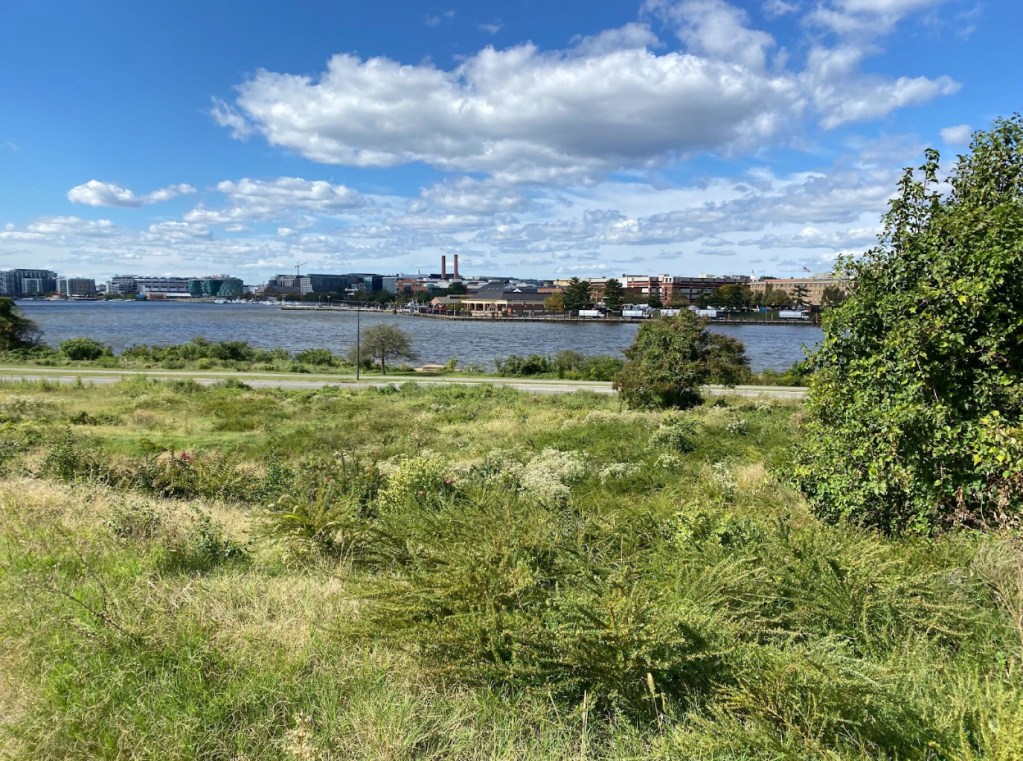
Those living in Anacostia say they struggle with hope for the future in the face of the pollution in the Anacostia River.
Sophia Kerby, a longtime D.C. resident and a consistent enjoyer of the Anacostia River hopes to raise a family near the water. “The river is part of why I moved here. I wanted to live closer to my community, in a more Black neighborhood,” said Kerby.
The future preservation of the river for Kerby looks and “feels like a safe space and not one that is tailored for a different population or a different community.”
The Anacostia Watershed Society, a nonprofit that uses community organizing to protect and restore the Anacostia River for those living in its watershed, says the river is important for recreation, industrialization, and natural systems. The Anacostia River is the District’s and Maryland’s largest watershed.
The river spans 176 square miles and is home to over one million people. On the Anacostia Watershed Society’s website, they say the river is still “recovering from centuries of industrialization and pollution.”
The Office of the Attorney General for the District of Columbia announced on Oct. 3 that after Attorney General Brian Schwalb filed lawsuits against the power company, Pepco has to pay a $57 million environmental settlement to the district attorney. The Potomac Electric Power Company (Pepco) is the power company that serves the D.C. and Maryland area.
In a statement on Twitter, Schwalb said, “Pepco routinely discharged hazardous chemicals into the environment, contaminating the Anacostia River and threatening the surrounding communities’ health and safety.”
Peter Drekmeier, Policy Director for Tuolumne River Trust, says river health is essential to the overall condition of the residents of Anacostia because without a clean space to play and drink people suffer. Next steps for the distribution of the settlement include “listening to the community and finding out what their day to day challenges are” so that the negative impacts in Anacostia can be tackled holistically, said Drekmeier.
Attorney General Schwalb acknowledged that the community affected is the people of color in Anacostia: “As is too often the case, communities of color East of the River bore the brunt of [Pepco’s] illegal conduct.”
In January 1999, the African American Heritage Preservation Foundation described Anacostia as “one of our Nation’s capital’s most significant African-American neighborhoods” in a plea to save the neighborhood as a historic landmark.
Others have acknowledged the racial inequity that appears in how Pepco’s dumping marred the land, water, and residents who live around the Anacostia River.
Black people who were banned, or later discouraged, from using segregated pools would swim in the Anacostia river, soaking up the chemicals from power plants and the city’s waste.
Dennis Chestnut, an Anacostia resident said to DCist, “We would be having so much fun just being in the water. If you can imagine, we would forget that we were actually right in the thick part of the city’s landfill.”
Carmel Henry, the Washington NAACP’s vice president, said at a press conference the Pepco settlement was “a significant step toward addressing the generational health impacts on lower-income Black communities;” however, those affected should be able to see and have a hand in how the money is getting put to use.
Because Black people have historically inhabited Anacostia, the environmental injustice committed in and around the neighborhood cannot be untangled.
Reagan Russell, a junior Environmental Studies major at Howard University who studied the environmental impacts of the Pepco power plant, said in her classes they have concluded “racism is the root of environmental injustice” and “fighting against environmental injustice and fighting to end racism and prejudice go hand in hand.”
Although the Anacostia River needs to be rid of chemicals, the community and neighborhoods next to the river are also part of Pepco’s environmental impacts. “Environmental issues don’t happen in a vacuum, they happen to the whole community,” said Gabrielle Wood, president of Howard University’s Water and Environment Association.
Anacostia Arts Center Is Undergoing Changes and Some Residents Are Concerned
Business Story
By Kayla Smernoff
Nov. 30, 2023
The front room of the Anacostia Arts Center is filled with music by Lauryn Hill, Victoria Monet, or Chlöe Bailey emanating from a portable speaker by the front windows.
The front space, which serves as the lounge, coworking space, and art gallery, has small round tables with people of all ages sitting and working. Business owners chat with customers and their coworkers, throughout the center and their storefront.
The Anacostia Arts Center opened June 22, 2013 and presents itself as a space for small business, community, and growth.
Front desk associate Jermaine Powell is the first person people see when entering the Arts Center. He said the center’s history and resources speak for themselves: “It’s a lot of people that come through here. Kevin Hart came through here and other big artists and book authors, like Michelle Obama. You meet a lot of people and have a lot of resources.”
The upper level of the center has the neighborhood’s only grocery store, a vintage clothing store, a theater, and the front gallery. Downstairs is a small space for independent work or for entrepreneurs participating in the creative business incubator program.
Over the summer, the Washington Area Community Investment Fund (WACIF), and its subsidiary The HIVE, announced $3 million in funding and raised the final amount of money necessary to reimagine the Anacostia Arts Center, according to the WACIF website.
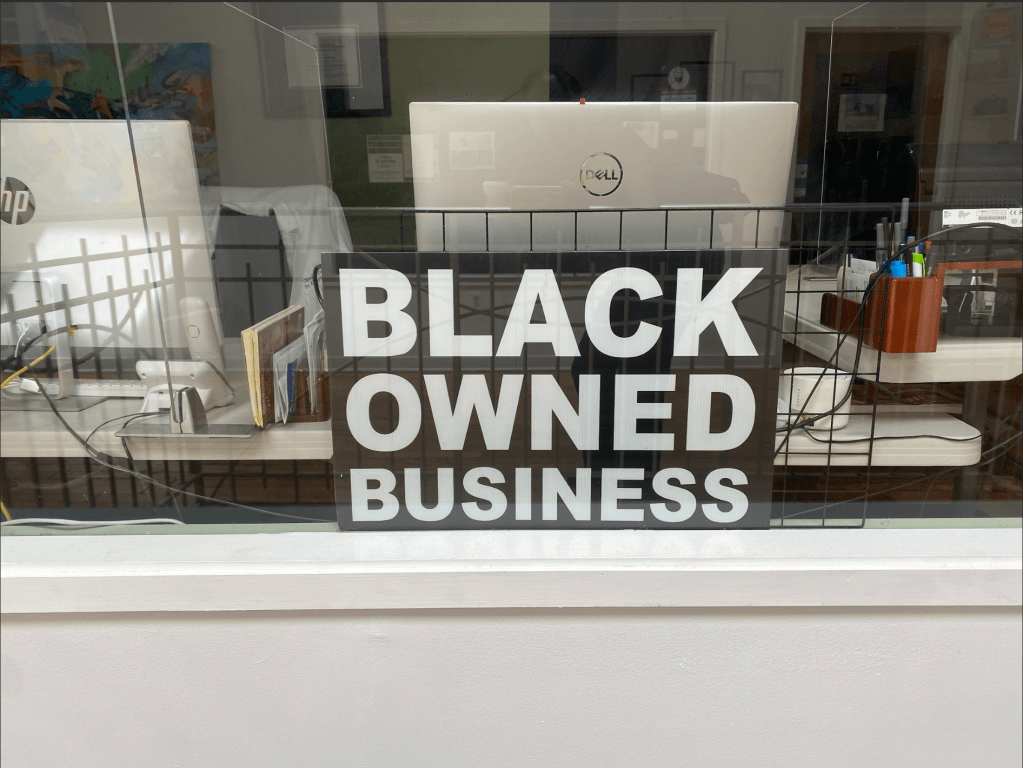
The Center will have two more stories which means more space for what Jess Randolph, the Anacostia Arts Center’s creative director, calls “affordable retail space” for Black-owned businesses.
“The Anacostia Arts Center has been home to a storefront retail incubator for years and a store front incubator is a temporary solution for growing businesses,” said Randolph.
Randolph said she believes that an investment from Washington Area Community Investment Fund will help continue the cycle of nurturing creatives and their businesses before sending them into Southeast or other parts of DC.
“I’m very confident that the Washington Area Community Investment Fund will make this space serve entrepreneurs in a way that was impossible before,” said Randolph.
As the Anacostia Arts Center evolves, the Arts Center’s front desk associate Jermaine Powell said the greater Anacostia area is changing as well. The Anacostia Arts Center and Washington Area Community Investment Fund websites pledge to prioritize diverse entrepreneurs and businesses and Powell is optimistic about the influx of attention on Southeast D.C.
“It’s a lot of black people coming into the neighborhood and opening up shops. That’s pretty good. This is really a prominent all Black area, but it’s changing for the good,” Powell said.
Some describe outside investment into the community as a positive while others said they are wary. Janell Henderson, a partial owner of Vintage and Charmed sustainable vintage shop, said she was concerned aboutWashington Area Community Investment Fund’s involvement with the Arts Center.
Speaking about the redevelopment, Henderson said, “I just wish the communication was one that was inclusive and I don’t think it is.”
A lack of communication has illuminated the idea that the Arts Center could be deprioritizing its current business owners and the community that makes the center special, said Henderson.
Anacostia has historically Black roots and currently many local Black-owned businesses. “What is special about Anacostia is that there is a community in it,” said Henderson. She said that most Black people have no opportunity to “put ourselves in a position where our Black dollar is recycled repeatedly.”
Rylinda Rhodes, an activist and business owner, said anxiety surrounding change seeps into the Anacostia community as well. Redevelopment is often a topic of discussion in the DC area, especially Ward 8.
Rhodes said Anacostia means “I can be in a safe space surrounded by a community that looks like me and that is eager to grow and evolve. We get to exist.”

 Kayla Smernoff